IJCRR - 5(8), April, 2013
Pages: 74-78
Date of Publication: 25-Apr-2013
Print Article
Download XML Download PDF
SEXUAL DIMORPHISM OF BICONDYLAR WIDTH OF FEMORA IN SOUTH INDIAN POPULATION
Author: Shanta Chandrasekaran, R. Sudha
Category: Healthcare
Abstract:Objectives: Aim of the study was to assess the values of bicondylar width of femora and to evaluate the sexual dimorphism. Methods: This analytical study was done in the department of anatomy from Vinayaka Missions Kirupananda Variyar Medical College, Annapoorana Medical College and Vinayaka Missions Homeopathy Medical College, Salem. All the dry adult femora of both sexes available in the above mentioned colleges were included and those which were damaged or having any pathological deformity were excluded from the study. Sex determination of all the femora were initially done by using distinct anatomical features. Maximum width between medial and lateral condyles of the femur was measured by using the vernier caliper and considered as bicondylar width. The mean values of the bicondylar width of both the sex were compared and demarking point was identified. The percentages, range, mean, standard deviation and p value were calculated using SPSS 15 (Statistical Package of Social Services) Results: The mean values of bicondylar width of male femora was 7.60 CM SD 0.38CM and female femora was 6.74 CM SD 0.34 CM. Male had higher value and it was statically significant (P< 0.001) Conclusion: Bicondylar width of femora in males was greater than bicondylar width of femora in females.
Keywords: Bicondylar width, Sexual dimorphism, Femur
Full Text:
INTRODUCTION
Sexual dimorphism in bony parts of long bone is gaining more attention in forensic osteology and in anthropology. Sexual dimorphism relies heavily on the advanced and updated techniques to get better information to medico-legal system. Determining the sex using visual method alone needs more experience of the observer and inter rater variation cannot be avoided. Recent advances in this field made a shift from visual analysis to anthropometric measurements which is more objective and the possibility of the inter rater variability could be minimized. Sex determination of person is easy when the entire skeleton is available, especially pelvis and the skull helps in determining the sex differentiation. (1) But it is difficult task for the forensic experts to determine the sex using the parts of long bones alone without skull or pelvis. Hence it is essential to undergo multiple researches on small parts of long bones to determine the sex. The role of bicondylar width of femora in sexual dimorphism is studied by many researchers in different populations. (2–7) The standards of morphological and morphometric attributes varies from one population to other population. It is a general rule that standards should be used with reference to population from which they are drawn; hence this study was aimed at measuring the maximal bicondylar width of the femora of both the sexes to determine the standards for sex determination in South Indian population.
MATERIALS AND METHODS
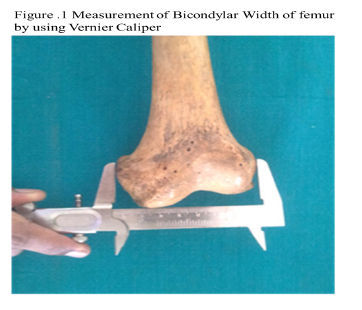
This analytical study was done in the department of anatomy from Vinayaka Missions Kirupananda Variyar Medical College, Annapoorana Medical College and Vinayaka Missions Homeopathy Medical College, Salem. All the dry adult femora of both sexes available in the above mentioned colleges were included and those which were damaged or having any pathological deformity were excluded from the study. Sex determination of all the femora were initially done by using distinct anatomical features. Using vernier caliper the maximum width between the most projected points of medial and lateral condyles of the femur in coronal plane was measured in centimetres (Fig 1).
STATISTICAL ANALYSIS
Data collected was tabulated. The mean values of the bicondylar width of both the sex were compared and demarking point was identified. The percentages, range, mean, standard deviation and p values were calculated using SPSS 15 (Statistical Package of Social Services). The resultant p value was less than 0.05 making it statistically significant.
RESULTS
Totally one hundred and ninety six femora were studied. Of which 133 were male femora and 66 were female femora. The mean of bicondylar width of over all femora(n=196) was 7.32 CM SD 0.54 CM with a range from 5.80 CM to 8.70 CM .The mean bicondylar width of male femora(n=133) was 7.60 CM SD 0.38CM with a range from 6.60CM to 8.70 CM. The mean bicondylar width of the female femora was 6.74 CM SD 0.34CM with a range from 5.80CM to 7.40 CM. Male femora showed higher bicondylar width than bicondylar width of female femora and it was statistically highly significant (p<0.001).
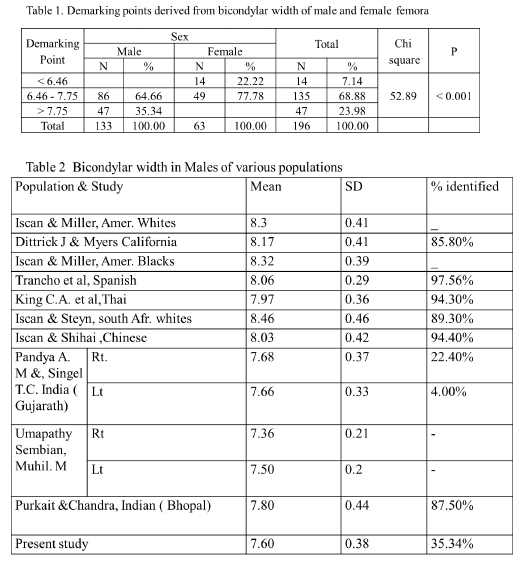
Using the minimum and maximum range of both male and female bicondylar width, the demarking points were derived as in table 1. Which were statically significant (p <0.001).
DISCUSSION
Our study shows that the male femora had higher bicondylar width comparing to female femora. This could be explained by the fact that the axial skeleton weight of the male is generally heavier than the female; the articular surfaces taking part in weight transmission are massive in male, which is resulted in higher value of bicondylar width in male on both the sides.
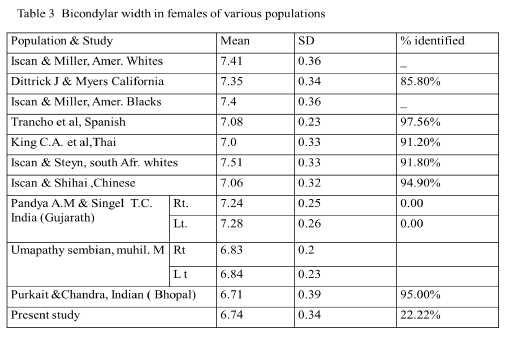
Comparison of bicondylar width in male and female and the use of demarking points in identifying the sexes of various populations including South African Whites, Thai, American Blacks, American Whites, Chinese’s, Spanish, Californian and Gujarat, Chennai, Bhopal in India are mentioned in Table 2 and Table 3. (2-6, 8-11) This difference could be because of various factors like genetic predisposition, environment, physical activities, diet and nutrition status.
Though it is easy to identify the sex of the femur as male when it is more than 7.75 and as female femur when it is <6.46 using the demarking points derived from this study, it is not possible to identify the sex when the bicondylar width is between 6.47 CM to 7.74CM, due to overlapping. Table 2 and 3 revealed that the present study and Pandya A.M study has given the low percentage of correct sexual classification comparing to others. This could be because these two studies used demarking points but the results of other studies were based on multivariate method. The percentage of correct sexual classification will be dropped down sharply when we use the demarking point method but the accuracy remain 100% for any sample from the same region and which is very much valued in medico legal point of view.(12)
CONCLUSION
This study concludes that the bicondylar width of femur in South Indian male population is higher than the bicondylar width of femur in South Indian female population, which helps in sex determination. Sexual determination of the femur bone is accurate, when the demarking point is used.
ACKNOWLEDGEMENT
The authors sincerely wish to thank the management, administrators and the Professor and Head of the departments of Anatomy of Vinayaka Missions Kirupananda Variyar Medical College, Annapoorana Medical College and Vinayaka Missions Homeopathy Medical College, Salem for their whole hearted support and permissions to utilize their resources and conduct this study.
Authors acknowledge the great help received from the scholars whose articles cited and included in references of this manuscript. The authors are also grateful to authors / editors / publishers of all those articles, journals and books from where the literature for this article has been reviewed and discussed. Authors are grateful to IJCRR editorial board members and IJCRR team of reviewers who have helped to bring quality to this manuscript.
References:
- Krogman, W. M. and Iscan, M. Y. Human Skeleton in Forensic Medicine. 2nd Edition, Charles C. Thomas, Springfield, 1986.
- Dittrick J. and Suchey J. M., Sex determination of prehistoric central California skeleton remains using discriminant analysis of the femur and humerus, American Journal of Physical Anthropology 1986; 70: 3-9.
- King C.A., Iscan M. Y. and Loth S.R., Metric and comparative analysis of sexual dimorphism in the Thai Femur. Journal of Forensic Science 1998; 43(5): 954–958.
- Iscan M.Y. and Miller-Shaivitz P., Determination of sex from the femur in blacks and whites. Coll. Antropol. 1984; 8(2):169–75. as cited by King C.A. et al, 1998
- Steyn M. and Iscan M. Y., Sex determination from the femur and tibia in South African whites, Forensic Science International 1997; 90: 111-119.
- Iscan M.Y. and Shihai D., Sexual Dimorphism in the Chinese Femur. Forensic Science International June 1995; 74(1-2): 79-87.
- Singh S. P. and Singh S., The sexing of adult femora: Demarking points for Varanasi zone, Journal of the Indian Academy of Forensic Sciences 1972 B; 11:1- 6.
- Purkait R. and Chandra H., Sexual Dimorphism in Femora: An Indian Study. Forensic Science Communications 2002 July; 4(3): 1-6.
- Trancho G. J., Robledo, B., Lopez-Bueis I., and Sanchez S.A. Sexual determination of femur using discriminant function analysis of a Spanish population of known sex and age, Journal of Forensic Sciences 1997; 42:181-185.
- Pandya A. M, Singel T.C, Patel M.P, Dangar K.P. Sexual Dimorphism of Bicondylar width of Femora. NJIRM 2011; Vol. 2(4): 68-71
- UmapathySembian, Muhil. M, Srimathi.T, Muthukumar.T, Nalinakumari.S.D. A Study of Sexual Dimorphism in Femora of Rural Population of South Tamilnadu, India. Journal of Clinical and Diagnostic Research. 2012 April, Vol-6(2): 163-165.
- Pal G.P., Reliability of criteria used for sexing of hip bone. Journal of Anatomical Society of India. 2004; 53 (2): 58-60.
|
 IJCRR
IJCRR 





 This work is licensed under a Creative Commons Attribution-NonCommercial 4.0 International License